Free RBT Practice Exam — 85 Questions, BACB-Aligned 2026

Reviewed by James Fuller, BCBA Last updated: July 12, 2026

Take two full 85-question BCBA-reviewed practice exams — 170 unique questions total. Each version covers all 6 task list domains with scenario-based questions modeled on the real BACB exam format. Free, instant scoring, no signup required..

Quick facts about this practice exam
Questions 170 total (2 versions)
Per version 85 (75 scored + 10 pilot)
Time 90 min per version
Pass target 80%+ correct
Cost Free, no signup
Coverage All 6 domains
Reviewer James Fuller, BCBA
Format Instant scoring
1

Practice Exam Version 1

/85

RBT Practice Exam Version 1

What to expect on this RBT practice exam

This BCBA-reviewed practice exam matches the real BACB RBT exam format. You'll answer 85 scenario-based questions covering all 6 task list domains, then receive instant scoring with detailed explanations for every answer.

  • 85 questions across all 6 task list domains (3rd Edition)
  • Recommended time: 90 minutes
  • Pass-readiness target: 80% correct (~68 of 85)
  • Instant scoring with explanations after each question
  • Every explanation links to the relevant study guide or topic quiz

1 / 85

1. A caregiver tells the RBT that the client did not sleep well last night and ate a large breakfast immediately before the session. During the session, the client performs much worse than usual. The RBT should:

2 / 85

2. A client's grandmother arrives at a session and asks the RBT for an update on the client's progress. The grandmother is NOT on the authorized list of contacts. The RBT should:

3 / 85

3. Which of the following session note entries is MOST objective and appropriate?

4 / 85

4. Forward chaining is BEST chosen over backward chaining when:

5 / 85

5. A behavior occurs in brief bursts of high frequency, followed by long pauses with no occurrences. The team uses momentary time sampling with 10-minute intervals. What is the MOST LIKELY measurement error?

6 / 85

6. A learner has mastered the skill of identifying colors using picture cards. The team wants the skill to generalize to identifying colors of real-world objects (shirt, car, food). To program for STIMULUS generalization, the RBT should:

7 / 85

7. A learner becomes dependent on a verbal prompt and will not respond unless the prompt is delivered. Which procedure is MOST appropriate to address prompt dependence?

8 / 85

8. Latency recording is the MOST appropriate measure when the team wants to:

9 / 85

9. An RBT is reinforcing a learner on a VR-5 schedule. After many sessions, the supervisor instructs the RBT to change to a VR-15 schedule. The MOST LIKELY clinical reasoning is:

10 / 85

10. An RBT is asked to administer the client's medication during sessions because 'the parents don't have time.' The RBT should:

11 / 85

11. Whole-interval recording is MOST appropriate when the team wants to:

12 / 85

12. Which of the following is appropriate to include in an RBT session note?

13 / 85

13. Two RBTs independently record frequency of vocal stereotypy across 10 one-minute intervals. RBT 1 records: 3, 2, 0, 1, 4, 0, 2, 1, 3, 0. RBT 2 records: 2, 2, 0, 2, 3, 0, 2, 1, 2, 1. What is the interval-by-interval IOA percentage (intervals where both observers recorded the same count)?

14 / 85

14. Extinction should generally NOT be used when:

15 / 85

15. Functional communication training (FCT) is BEST described as:

16 / 85

16. An RBT has been receiving regular BCBA supervision but the supervisor has been increasingly unavailable for monthly meetings. The RBT has not received required supervision for 6 weeks. The RBT should:

17 / 85

17. An RBT documents that a session started at 9:00 AM and ended at 11:00 AM (2 hours). The billing department later asks the RBT to change the documentation to show 1 hour to align with what was authorized. The RBT should:

18 / 85

18. Non-contingent reinforcement (NCR) is BEST described as:

19 / 85

19. An RBT's spouse is hired by the same agency. They are assigned to be the supervisor of the RBT. The MOST appropriate action is to:

20 / 85

20. Which of the following is the LEAST appropriate use of DRO?

21 / 85

21. A learner engages in self-injurious head-banging during demand situations. The BIP includes presenting easy-to-difficult tasks gradually, providing frequent breaks, and reinforcing breaks-on-request. Which TYPE of intervention is the BIP using PRIMARILY?

22 / 85

22. An RBT is teaching a learner to imitate motor movements. The SD is 'Do this' followed by the RBT raising both arms. The learner correctly raises both arms. This response is BEST described as:

23 / 85

23. Baseline data on aggression show: 4, 5, 4, 5, 4, 4, 5 (counts across 7 sessions). After intervention, data show: 3, 1, 4, 0, 5, 2, 1, 3, 0, 1. The supervisor wants to evaluate the data. What is the MOST important baseline feature for evaluating the effect of intervention?

24 / 85

24. An RBT records the following times of self-injurious behavior episodes during a 30-minute session: 4:02, 4:09, 4:14, 4:20, 4:31. The supervisor asks the RBT to summarize the time pattern between successive episodes. Which measurement dimension would BEST capture this information?

25 / 85

25. A behavior is maintained by both attention AND escape (multiple functions). Which intervention approach is MOST appropriate?

26 / 85

26. A learner's BIP specifies a 2-minute DRO interval. After successful implementation for 2 weeks, the supervisor wants to increase the interval. The MOST appropriate next interval is:

27 / 85

27. An RBT believes that the supervisor's BIP is not the most effective approach for the client. The RBT has experience that suggests a different approach would work better. The MOST appropriate course of action is to:

28 / 85

28. A learner is being taught new social skills using BST. The RBT models the skill, the learner rehearses, and the RBT provides corrective feedback. After many trials, the learner can perform the skill in the therapy session but does NOT generalize the skill to real-world social interactions. The MOST appropriate next step is to:

29 / 85

29. Which of the following is the LEAST intrusive prompt level in a typical response-prompt hierarchy?

30 / 85

30. Discrete-trial teaching (DTT) is BEST described as:

31 / 85

31. A learner is being taught to identify the letter 'B' from an array containing B, D, P, and R. After many trials, the learner picks B correctly when shown a black B against a white background but incorrectly when the B is presented in a different font or color. This is BEST described as:

32 / 85

32. An RBT notices a small unexplained bruise on a client during a session. The caregiver hasn't mentioned it. The MOST appropriate action is:

33 / 85

33. An RBT is implementing a behavior plan with both extinction and DRA. The learner's problem behavior decreases steadily, but the RBT notices the learner shows new behaviors not previously seen (e.g., crying, hitting different objects). This is BEST described as:

34 / 85

34. A learner has been receiving full physical prompts to complete a task. The supervisor wants to begin fading prompts using a least-to-most hierarchy. On the next trial, the RBT should:

35 / 85

35. An RBT is asked to assist with a curriculum-based assessment for a 4-year-old client. The assessment includes 30 items spanning expressive language, receptive language, motor imitation, and intraverbal skills. Halfway through, the child becomes uncooperative. The MOST appropriate next step is to:

36 / 85

36. An EO (establishing operation) and an SD (discriminative stimulus) differ in that:

37 / 85

37. A learner has a history of being reinforced on a thick (lean) intermittent schedule for a target behavior. Compared to a learner reinforced on CRF for the same behavior, the lean-schedule learner will likely show:

38 / 85

38. Which of the following BEST describes 'reactivity' in behavioral measurement?

39 / 85

39. A client's caregiver wants to express gratitude to the RBT and offers cash as a tip. The RBT should:

40 / 85

40. An RBT discovers that a colleague is consistently billing for sessions that were never delivered. The RBT should:

41 / 85

41. Which of the following is NOT a stimulus prompt?

42 / 85

42. An RBT is asked to graph cumulative correct responses across 10 sessions. The data show that the cumulative curve flattens during sessions 6, 7, and 8, then rises sharply in session 9 and 10. What does the flat portion of the curve indicate?

43 / 85

43. A parent reports that their child 'becomes aggressive when frustrated.' For this report to be useful, the RBT should help operationalize the report by:

44 / 85

44. A learner reliably selects items in an array but consistently picks the item closest to their dominant hand regardless of preference. Which preference assessment method is MOST appropriate to control for this position bias?

45 / 85

45. A learner says 'doggy' when seeing a dog (a tact). Later, when their parent asks 'What barks?', the learner says 'doggy.' This second response is a:

46 / 85

46. A client's screaming has been on extinction for 4 weeks and has reduced to near-zero. After a 1-week break in therapy, screaming briefly reappears on the first day back, even though no reinforcement is delivered. The RBT should:

47 / 85

47. Which of the following is the BEST example of a continuous measurement procedure?

48 / 85

48. An RBT conducts an MSWO preference assessment with 6 items. After 3 trials, the same item has been chosen first each time. The supervisor asks the RBT to repeat the assessment a week later. The MOST LIKELY rationale is:

49 / 85

49. An RBT teaches the SD 'cookie' and the response 'cookie' (vocal). The learner says 'cookie' under deprivation and receives a cookie. Later, when shown a cookie, the learner is asked 'What is this?' and says 'cookie' — receiving social praise. The first instance is a __ and the second is a __.

50 / 85

50. An RBT calculates that two observers agreed on 7 of 10 intervals (some marked occurrence, some non-occurrence). Both observers' OCCURRENCE-only agreement (intervals where BOTH marked occurrence ÷ intervals where AT LEAST ONE marked occurrence) is 50%. What does this tell the supervisor?

51 / 85

51. An RBT has a 1-hour gap between client sessions. The agency policy allows the RBT to bill 'travel time' between sessions but only for actual travel. During the gap, the RBT runs personal errands and arrives at the next session on time. How should the RBT document and bill the time?

52 / 85

52. An RBT records that during a 20-minute session, a behavior occurred 8 times, with episodes lasting 30, 45, 15, 60, 20, 30, 25, and 35 seconds. What is the rate of behavior?

53 / 85

53. An RBT realizes after a session ends that they forgot to document a client behavior that occurred during the session. The supervisor's policy requires same-day documentation. The RBT should:

54 / 85

54. An RBT cancels a session due to weather emergency. The agency requires documentation of all missed sessions. The RBT should:

55 / 85

55. Behavior skills training (BST) consists of:

56 / 85

56. A learner has mastered making a peanut butter sandwich using a 12-step task analysis. The team wants to evaluate maintenance 30 days after teaching ends. The RBT should:

57 / 85

57. An RBT works with a client who lives in the same neighborhood. The RBT runs into the client and the client's parent at a local park during off-hours. The MOST appropriate response is to:

58 / 85

58. A scatter plot reveals that a behavior occurs almost exclusively between 10:00-11:00 AM on weekdays. The MOST useful next step is to:

59 / 85

59. Which assessment yields the STRONGEST evidence about behavior FUNCTION?

60 / 85

60. Antecedent-based interventions are PREFERRED over consequence-based interventions when possible because:

61 / 85

61. An RBT is feeling burned out and is making more clinical errors during sessions. The MOST appropriate professional response is to:

62 / 85

62. Differential reinforcement of low rates (DRL) is MOST appropriately used when:

63 / 85

63. A token economy has been in place for 3 months and was working well. Recently, the learner stopped engaging in the target behavior despite continued token delivery. The MOST LIKELY cause is:

64 / 85

64. Which of the following BEST describes the difference between objective and subjective documentation?

65 / 85

65. The RBT is asked to assist with an ABC observation. The supervisor specifies that the RBT should NOT intervene in the behavior at all — only record. The MOST IMPORTANT rationale for this restriction is:

66 / 85

66. Which of the following BEST illustrates an EO in clinical context?

67 / 85

67. DRA and DRI differ in that:

68 / 85

68. A learner is being taught to button a shirt using backward chaining. The RBT physically performs steps 1-7 and the learner independently performs step 8 (the last step). When the learner masters step 8, the next phase requires the learner to independently perform:

69 / 85

69. An RBT is implementing extinction for a behavior previously reinforced on a CRF schedule. Compared to extinction of a behavior reinforced on an intermittent schedule, this extinction will likely be:

70 / 85

70. A continuous reinforcement (CRF) schedule is MOST appropriate during which phase of skill teaching?

71 / 85

71. A caregiver asks the RBT to email session notes to the caregiver's personal Gmail address because 'the agency portal is slow.' The RBT should:

72 / 85

72. A learner consistently makes the same incorrect response when given the SD 'Touch red.' The supervisor instructs the RBT to use most-to-least prompting with errorless learning principles. On the next trial, the RBT should:

73 / 85

73. A learner shows interest in cars during free play. The RBT begins delivering cars contingent on saying 'car please.' Initially, the learner says 'car please' frequently and the RBT delivers a car each time. After many cars in a row, the learner stops requesting. The MOST LIKELY explanation is:

74 / 85

74. Stimulus equivalence refers to:

75 / 85

75. An RBT is approached by another therapy provider (e.g., a speech therapist) who wants to coordinate care. The other provider has NOT been authorized by the client's parents to share information. The RBT should:

76 / 85

76. An RBT is at a coffee shop when a community member asks, 'Aren't you working with the Anderson family? How is little Sam doing?' The MOST appropriate response is to:

77 / 85

77. A learner has reached criterion on a target skill but only responds correctly when the same RBT delivers the SD. With other instructors, the learner does not respond. This is BEST described as:

78 / 85

78. An RBT delivers an SD and waits 0 seconds (no delay) for the first prompt level — a full verbal model. On the next trial, the prompt is delayed by 2 seconds. On the next, 4 seconds. This procedure is called:

79 / 85

79. An RBT uses partial-interval recording with 15-second intervals during a 10-minute observation. The behavior is recorded in 24 of 40 intervals. What does this NOT directly tell you?

80 / 85

80. An RBT is asked by a parent to provide their opinion about whether the client should be placed in a special education classroom versus general education. The MOST appropriate response is to:

81 / 85

81. An RBT collects data on percent correct on a daily skill probe. Across sessions, scores are: 60%, 90%, 30%, 85%, 40%, 95%. The data show:

82 / 85

82. An RBT is asked to measure on-task behavior during a 45-minute math period. The behavior has fuzzy onset/offset, occurs at moderate frequency, and the RBT must simultaneously deliver instruction. Which measurement method is MOST appropriate given these constraints?

83 / 85

83. Total task chaining is MOST appropriate when:

84 / 85

84. A free-operant preference assessment is MOST appropriate when:

85 / 85

85. A learner's BIP includes both DRA (reinforcing 'help please') and extinction (no longer reinforcing screaming with escape from demands). During the first week, screaming becomes more intense and lasts longer. The RBT should:

Your score is

0%

2

Practice Exam Version 2

/85

RBT Practice Exam 85 Questions Free V2

What to expect on this RBT practice exam

This BCBA-reviewed practice exam matches the real BACB RBT exam format. You'll answer 85 scenario-based questions covering all 6 task list domains, then receive instant scoring with detailed explanations for every answer.

  • 85 questions across all 6 task list domains (3rd Edition)
  • Recommended time: 90 minutes
  • Pass-readiness target: 80% correct (~68 of 85)
  • Instant scoring with explanations after each question
  • Every explanation links to the relevant study guide or topic quiz

1 / 85

1. An RBT documents that at 2:15 PM (A: math worksheet placed on desk), (B: learner threw pencil), (C: RBT removed the worksheet). This is:

2 / 85

2. A learner engaged in vocal stereotypy 45 times during a 90-minute observation. What is the rate?

3 / 85

3. An RBT observes bruises on a young child that appear to be from abuse. The RBT should:

4 / 85

4. A client engages in hand-flapping that is maintained by sensory feedback (automatic reinforcement). Why is extinction difficult for this behavior?

5 / 85

5. An RBT wants to add a client's parent as a friend on Facebook. This:

6 / 85

6. A scatter plot shows that a behavior occurs mostly between 10-11 AM and 2-3 PM. What does this tell the BCBA?

7 / 85

7. A learner is playing with cars. The RBT notices the learner grabs a red car and takes this natural opportunity to teach color identification. Which teaching approach BEST describes this?

8 / 85

8. A client hit the RBT during a session, causing a small bruise. The RBT should:

9 / 85

9. A token economy is set up so that the learner earns 1 token after every 5 correct responses. This is an example of which reinforcement schedule?

10 / 85

10. An RBT uses 30-second intervals and marks each interval only if the behavior occurred for the ENTIRE interval. This method:

11 / 85

11. A BCBA sets up conditions where attention, escape, alone, and tangible variables are systematically manipulated to determine what maintains a behavior. This is:

12 / 85

12. Observer A recorded 20 occurrences of a behavior. Observer B recorded 25. What is the total count IOA?

13 / 85

13. A learner has low motivation in structured tabletop settings but engages heavily in play. Which teaching approach is likely MORE effective?

14 / 85

14. A parent tells an RBT they want the child's program modified. The RBT should:

15 / 85

15. An RBT is unsure whether a specific behavior is ethical. The RBT should:

16 / 85

16. An RBT conducts an MSWO preference assessment. On trial 1, the learner picks item A. On trial 2, what should the RBT do?

17 / 85

17. A BCBA administers the MAS (Motivation Assessment Scale) to the client's teacher and parent. This is:

18 / 85

18. The RBT suspects their supervising BCBA is intoxicated during a supervision session. The RBT should:

19 / 85

19. An RBT is measuring how long a learner's tantrums last from onset to end. This is called:

20 / 85

20. A parent asks the RBT to interpret the results of a functional analysis. The RBT should:

21 / 85

21. A learner throws work materials only when presented with math demands. The throwing stops when demands are removed. What is the likely function?

22 / 85

22. An RBT sets a timer for 60-second intervals. At the END of each interval, the RBT checks if the target behavior is occurring. This is:

23 / 85

23. A client becomes aggressive and starts throwing furniture. The BIP has a specific crisis protocol. What should the RBT do?

24 / 85

24. An RBT places the correct picture card slightly closer to the learner to make it easier to select. What type of prompt is this?

25 / 85

25. An RBT is teaching a child to tie shoes. The RBT physically prompts all steps except the final step (pulling the loops), which the child does independently for reinforcement. Which chaining method is used?

26 / 85

26. An RBT presents an SD, waits exactly 4 seconds, then provides a verbal prompt if the learner hasn't responded. This same 4-second delay is used on every trial. What is this procedure?

27 / 85

27. The RBT presents an SD and waits 3 seconds. If the learner doesn't respond, the RBT provides a gestural prompt. If still no response, physical guidance is added. Which prompting strategy?

28 / 85

28. An RBT is preparing to renew their certification. Which is NOT required?

29 / 85

29. An RBT posts on Instagram: 'Just finished a great session with a client — such an inspiring day!' No name is given. Is this appropriate?

30 / 85

30. An RBT counts the number of math problems a learner completed on a worksheet. This is:

31 / 85

31. An RBT wants to build compliance momentum before a difficult task. The RBT presents 3 easy demands the learner reliably completes, then presents the difficult task. This is called:

32 / 85

32. An RBT learns the client started a new medication yesterday. The RBT should:

33 / 85

33. A client engages in shouting during instruction. The intervention plan says to deliver reinforcement every 5 minutes if shouting has NOT occurred during that interval. This is:

34 / 85

34. A learner mastered greeting the RBT with 'Hi' in the therapy room. When the learner encounters the same RBT at the grocery store, they say 'Hi'. What has occurred?

35 / 85

35. At the end of a session, the client's family gives the RBT an expensive gift ($200 value). The RBT should:

36 / 85

36. An RBT is writing a session note. Which of the following should NOT appear in the note?

37 / 85

37. An RBT sees a client's family in a restaurant. The client's mother introduces the RBT to a friend as 'our RBT for autism therapy.' The RBT should:

38 / 85

38. A learner is being taught to select 'cat' from an array of cat, dog, and bird pictures. The RBT rotates the position of the cat picture on every trial. Why?

39 / 85

39. A child sees a cookie on the counter and says 'cookie' while reaching for it. What verbal operant is this?

40 / 85

40. An RBT is at a coffee shop and receives a call from a coworker who asks about a specific client by name. The RBT should:

41 / 85

41. Which of the following is a CONTINUOUS measurement procedure?

42 / 85

42. An RBT is delivering positive reinforcement 8 seconds after each correct response. What should the RBT do?

43 / 85

43. A client engages in hair-pulling. The intervention reinforces the client for keeping both hands folded in lap. Why is this considered DRI?

44 / 85

44. An RBT wants to prevent a learner from making errors during discrimination training. The RBT starts by providing immediate physical prompts and gradually fades them. This approach is called:

45 / 85

45. A learner asks appropriate questions but does so 40 times per hour, disrupting the group. The BIP reinforces the learner if they ask 5 or fewer questions per hour. This is:

46 / 85

46. An RBT uses 10-second intervals and marks each interval if the behavior occurred at any point during it. This method:

47 / 85

47. What is the PRIMARY purpose of a preference assessment?

48 / 85

48. An RBT's BCBA has been on leave for 45 days. The RBT has been providing services without supervision. This is:

49 / 85

49. A learner mastered a target skill 3 months ago. The RBT tests the skill today without any recent teaching, and the learner still performs it correctly. This is an example of:

50 / 85

50. An RBT realizes halfway through a session that they've been using the wrong data collection method. What should the RBT do?

51 / 85

51. An RBT initially uses a full verbal model to teach the learner to say 'ball'. Over trials, the RBT fades the model to just 'b' and then to no prompt. The learner now says 'ball' independently. What has happened?

52 / 85

52. An RBT is having lunch with coworkers at a restaurant. A coworker asks about a specific client by name. The RBT should:

53 / 85

53. An RBT begins extinction for tantrums that were previously reinforced with escape from demands. During the first session, tantrums INCREASE in intensity. The RBT should:

54 / 85

54. A client engages in severe self-injurious behavior. When speaking with the family, the RBT should:

55 / 85

55. An RBT arrives for a session and realizes the required data sheets for a new program are missing. What should the RBT do?

56 / 85

56. An RBT is running discrete-trial teaching (DTT) trials to teach color identification. Between trials, the RBT immediately delivers the next SD without a pause. What should the RBT do?

57 / 85

57. The RBT holds up a picture of a dog. The child says 'dog' and receives verbal praise ('great job!'). What verbal operant is this?

58 / 85

58. When should an RBT enter session data into the agency system?

59 / 85

59. A learner's problem behavior was successfully reduced through extinction 2 weeks ago. Today, the behavior briefly reappears despite continued extinction. This is:

60 / 85

60. An RBT measures the time BETWEEN two successive occurrences of a target behavior. This is:

61 / 85

61. An RBT presents 2 items at a time and asks the learner to choose one, cycling through all possible pairs. This is:

62 / 85

62. A speech-language pathologist calls and wants to discuss a shared client's progress. There is no signed ROI on file. The RBT should:

63 / 85

63. An RBT's session ended 20 minutes early because the client was ill. The supervisor asks the RBT to bill for the full session. The RBT should:

64 / 85

64. An RBT says 'Put your shoes on' and waits until the learner starts putting shoes on. The time between the SD and the start of the response is:

65 / 85

65. A client's screaming is maintained by adult attention. The BCBA writes a plan that has the RBT deliver attention every 90 seconds regardless of behavior. This is:

66 / 85

66. Which of the following is written in objective, measurable language?

67 / 85

67. The RBT asks 'What do you drink?' and the child says 'juice'. What verbal operant is this?

68 / 85

68. A child screams every time they see the RBT looking at another child. The screaming stops when the RBT looks at them. What is the likely function?

69 / 85

69. A parent asks the RBT to explain what the graphed data means. The RBT should:

70 / 85

70. A child cries only when an iPad is placed out of reach. Crying stops when the iPad is returned. What is the function?

71 / 85

71. A learner completes all 7 steps of handwashing, but the RBT provides prompts only for step 4 (rinsing) where the learner struggles. All other steps are done independently. Which chaining method is being used?

72 / 85

72. An RBT is teaching a new skill. On trial 1, the RBT uses full physical prompt. On trial 2, partial physical. On trial 3, gestural. On trial 4, no prompt. What prompting strategy is this?

73 / 85

73. A learner is being taught to make a sandwich. The RBT teaches step 1 (get bread) to independence, then adds step 2 (open peanut butter jar). Which chaining procedure is this?

74 / 85

74. A behavior graph shows a downward-trending line during an intervention phase. What does this indicate?

75 / 85

75. A parent asks the RBT to work with a new client who has a diagnosis the RBT has never encountered. The RBT should:

76 / 85

76. An RBT reinforces any vocalization at first, then only word-like sounds, then 'cook', then 'cookie'. This is an example of which procedure?

77 / 85

77. An RBT is reviewing a new skill acquisition plan. Which of the following is NOT a required component?

78 / 85

78. A learner strongly prefers a specific toy in a preference assessment. However, when the toy is used as a reward, the target behavior does NOT increase. What's happening?

79 / 85

79. A client's mother offers to hire the RBT as a private babysitter on weekends. The RBT should:

80 / 85

80. A token economy has been in place for 2 weeks. The learner used to earn tokens eagerly but is now refusing to work. The reinforcer being purchased (candy) hasn't changed. What's the MOST likely explanation?

81 / 85

81. A parent asks the RBT to design a new behavior intervention for their child. The RBT should:

82 / 85

82. A client hits others to gain attention. The intervention plan calls for reinforcing appropriate requests for attention while not reinforcing hitting. What procedure is this?

83 / 85

83. An RBT places multiple preferred items in a room and observes which items the learner engages with, and for how long. This is:

84 / 85

84. An RBT is reviewing a Behavior Intervention Plan (BIP). Which of the following is REQUIRED in a well-written BIP?

85 / 85

85. The BCBA gives corrective feedback to an RBT about procedural fidelity. The RBT should:

Your score is

0%

What your RBT practice exam score means

The official RBT exam uses a scaled scoring system and the BACB does not publish a fixed pass percentage, but the working benchmark is roughly 80% correct on the 75 scored questions — about 60 right answers. On this 85-question practice exam, aim for 68+ correct (80%) before sitting the real test.

How to read your score on this mock exam

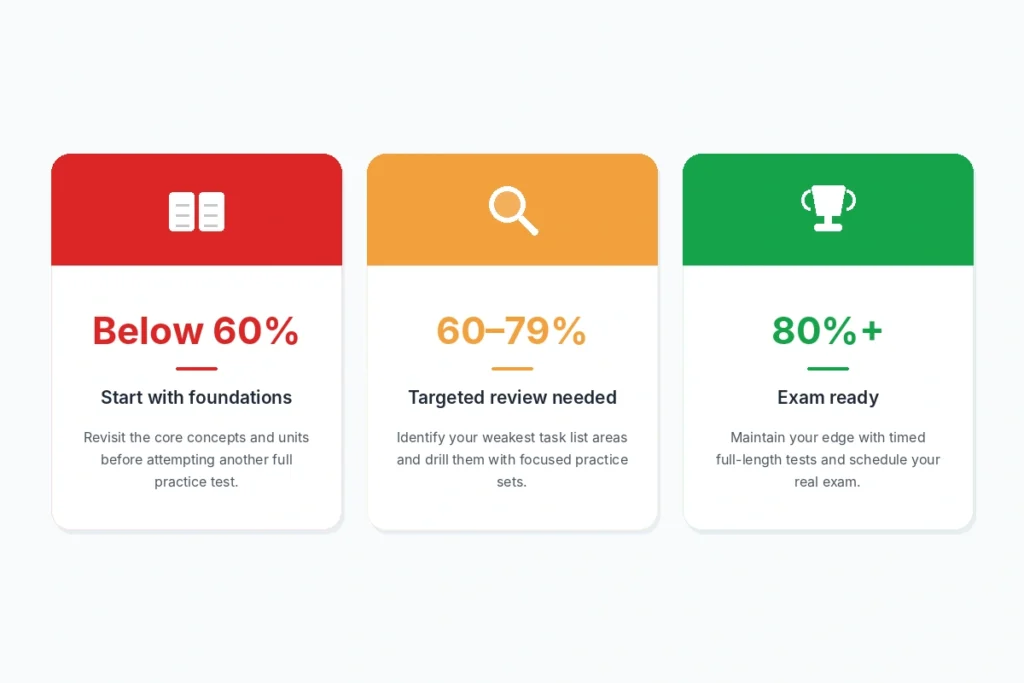
If you scored 80% or above on this practice exam, you’re in real-exam territory. Take it once more after a few days to confirm the score wasn’t a single good session, then book your Pearson VUE appointment with confidence.

If you scored 60–79%, you’re close but not ready. The gap is almost always in one or two specific task list domains rather than across the board. Look at which sections you missed most often — that’s where to focus the next two weeks of study.

If you scored below 60%, treat this exam as a diagnostic rather than a readiness check. Most candidates in this range haven’t yet finished the 40-hour training or haven’t reviewed the RBT Task List in depth. Go back to the RBT Study Guide and work through each domain systematically.
RBT PRACTICE EXAM SCORE BANDS

What to do right now, based on your weakest domain

Use the results screen above to identify the domain you scored lowest on, then drill it directly:

What is the RBT exam?

The RBT exam is the certification test administered by the Behavior Analyst Certification Board (BACB) for candidates seeking the Registered Behavior Technician credential. It contains 85 multiple-choice questions (75 scored, 10 unscored pilot items), runs 90 minutes, and is delivered in person at Pearson VUE testing centers.

How the RBT exam is structured

The exam covers six domains of the RBT Task List (3rd Edition). Each question presents four answer options with one correct answer. The questions are not labeled — you won’t know which 75 are scored and which 10 are pilot items, so treat every question as if it counts.

RBT Exam ElementDetail
Total questions85 (75 scored + 10 unscored pilot)
Time limit90 minutes
Question typeMultiple choice, 4 options each
Passing benchmark~80% correct on scored items (modified Angoff scaling)
Test formatIn-person, Pearson VUE testing center
Attempts allowedUp to 8 within 12 months from authorization
Wait between attempts7 days minimum
BACB application fee$65
Pearson VUE exam fee$45

Who is eligible to take the RBT exam

To sit the RBT exam, you must:

  • Be at least 18 years old
  • Hold a high school diploma (or equivalent)
  • Complete a BACB-approved 40-hour RBT training
  • Pass the Initial Competency Assessment with a qualified BCBA, BCaBA, or BACB-approved supervisor
  • Pass a background check
  • Submit your application and the $65 fee to BACB

Once your application is approved, you’ll receive authorization to schedule with Pearson VUE.

How the RBT exam is scored

The RBT exam uses a modified Angoff method: BACB subject-matter experts pre-assign a difficulty rating to each question, and your raw score is converted to a scaled score. Because difficulty varies between exam forms, the BACB doesn’t publish a fixed percentage. The widely-used rule of thumb is 60 of 75 scored questions correct ≈ pass.

You’ll receive your result immediately at the testing center — there’s no waiting period.

For a deeper walkthrough of exam format, scoring, and registration, see our complete RBT Exam guide. For passing score specifics, see what is a passing score for the RBT exam.

How to use this RBT practice exam effectively

Take this 85-question mock exam at least twice during your study period: once early to diagnose weak domains, and once 3-5 days before your real exam to confirm readiness. Between the two attempts, drill your weakest domains using the topic quizzes, then review the answer explanations for every question you got wrong.

A 4-step study cycle that works

  1. Diagnose — Take this practice exam under real conditions (90 minutes, no notes, no breaks). Score honestly. Note which domain(s) you scored lowest on.
  2. Drill — Spend the next 7-14 days on your two weakest domains. Use the RBT Study Guide for content review and the matching topic quiz for active recall.
  3. Simulate — Retake this 85-question exam. Compare scores. The gap between attempt 1 and attempt 2 tells you whether your study method is working.
  4. Confirm — In your final week, take the 75-question variant and the Pearson-style mock to confirm consistency across formats.

Mimic real exam conditions

The closer your practice conditions are to the real test, the more reliable your score:

  • Set a 90-minute timer (don’t pause)
  • Use a quiet space — no phone, no music, no notes
  • Don’t look up answers until the timer ends
  • Use a single screen with no other tabs open

Avoid the common practice-test mistake

Many candidates take the same practice exam four or five times and watch their score climb to 95% — but that’s not skill, that’s memory. If you’ve already taken this 85-question exam twice, switch to a different format:

Varying the question pool forces real recall instead of pattern recognition.

What does the RBT exam cover? The six task list domains explained

The RBT exam (3rd Edition Task List) covers six domains: Measurement (Data Collection & Graphing), Behavior Assessment, Skill Acquisition, Behavior Reduction, Documentation & Reporting, and Professional Conduct & Scope of Practice. Each domain has a different weighting on the real exam, with Measurement and Skill Acquisition typically representing the largest shares.

Domain A — Measurement (Data Collection & Graphing)

What it tests: Your ability to collect, record, and graph behavioral data using the measurement procedures specified by a BCBA.

Key concepts you must know:

  • Continuous measurement: frequency, rate, duration, latency, IRT
  • Discontinuous measurement: partial interval, whole interval, momentary time sampling
  • Permanent product recording
  • Calculating rate, mean, percentage
  • Creating and interpreting line graphs and bar graphs
  • Identifying trend, level, and variability in data

Why candidates lose marks here: Confusing partial interval (recorded if behavior occurred at all during the interval) with whole interval (recorded only if behavior occurred for the entire interval). These two measurement systems have opposite biases — partial interval tends to overestimate, whole interval tends to underestimate.

Drill this domain: Data Collection & Graphing Quiz · Measurement Study Guide

Domain B — Behavior Assessment

What it tests: Your role in supporting a BCBA’s assessment work — never independently conducting assessments.

Key concepts you must know:

  • Preference assessments (single stimulus, paired stimulus, MSWO, free operant)
  • ABC (Antecedent-Behavior-Consequence) data collection
  • Environmental assessment (setting events, stimuli, distractions)
  • Assisting with functional assessments — under BCBA direction
  • Recognizing when to refer something to the supervisor rather than act independently

Why candidates lose marks here: Treating RBT as a role that conducts assessments. RBTs assist with assessments designed and interpreted by a BCBA. If a question implies the RBT is making clinical decisions about assessment results, the answer is wrong.

Drill this domain: Behavior Assessment Quiz · Assessment Study Guide

Domain C — Skill Acquisition

What it tests: How you implement behavior-acquisition programs written by a BCBA.

Key concepts you must know:

  • Discrete trial training (DTT) procedures
  • Naturalistic teaching strategies (incidental teaching, NET)
  • Chaining: forward, backward, total task
  • Shaping and successive approximations
  • Prompting and prompt fading hierarchies (most-to-least, least-to-most)
  • Reinforcement schedules and contingencies
  • Generalization and maintenance procedures
  • Token economies and group contingencies

Why candidates lose marks here: Misidentifying which prompt level is being used in a scenario. Watch for the distinction between physical, gestural, model, verbal, and positional prompts — and always read carefully whether the prompt is being faded or intensified.

Drill this domain: Behavior Acquisition Quiz · Skill Acquisition Study Guide

Domain D — Behavior Reduction

What it tests: Implementing behavior intervention plans (BIPs) to reduce challenging behavior — always under BCBA-written direction.

Key concepts you must know:

  • Functions of behavior: attention, escape, access to tangibles, automatic/sensory
  • Differential reinforcement schedules (DRA, DRO, DRI, DRL)
  • Extinction procedures and extinction bursts
  • Crisis/safety procedures and de-escalation
  • Recognizing when to discontinue and contact the BCBA
  • Antecedent-based vs. consequence-based interventions

Why candidates lose marks here: Choosing punishment-based answers when a differential reinforcement option is also listed. The correct answer almost always favors reinforcement-based and least-restrictive procedures.

Drill this domain: Behavior Reduction Quiz · Behavior Reduction Study Guide

Domain E — Documentation & Reporting

What it tests: How you record session notes, maintain confidentiality, and communicate with your supervisor.

Key concepts you must know:

  • Objective vs. subjective language in session notes
  • HIPAA and client confidentiality requirements
  • Mandated reporting (suspected abuse or neglect)
  • Communicating relevant information to the BCBA in a timely manner
  • Recording session data accurately and contemporaneously
  • Documentation of session changes, cancellations, and incidents

Why candidates lose marks here: Using interpretive or judgmental language in session-note examples. RBTs document what happened — observable, measurable events — not their interpretation of why.

Drill this domain: Documentation & Reporting Quiz · Documentation Study Guide

Domain F — Professional Conduct & Scope of Practice

What it tests: The BACB Ethics Code for Behavior Analysts as it applies to RBTs, plus your understanding of your scope of practice.

Key concepts you must know:

  • Maintaining professional boundaries with clients and families
  • Avoiding multiple/dual relationships
  • Receiving and responding to supervisor feedback
  • Identifying conflicts of interest
  • Reporting ethical violations
  • Recognizing the limits of the RBT scope — what you can and cannot do without supervision

Why candidates lose marks here: Picking the answer that solves the immediate problem instead of the answer that defers to the BCBA. When in doubt on an ethics question, the correct action is usually “consult the supervisor.”

Drill this domain: Ethics Practice Quiz · Ethics Study Guide

What are the most common mistakes test-takers make on the RBT exam?

The five most common RBT exam mistakes are: acting outside the RBT scope of practice, confusing partial vs. whole interval recording, picking punishment over differential reinforcement, misreading “best next step” scenarios, and rushing through the last 20 questions. All five are pattern errors, not knowledge gaps — they show up even in candidates who studied well.

1. Answering as if the RBT can make clinical decisions

The RBT scope of practice is implementation under BCBA supervision, not independent decision-making. If a question asks what an RBT should do and one option involves changing a program, modifying a BIP, or interpreting assessment data, that answer is almost always wrong. The correct answer typically involves continuing the protocol as written and contacting the supervisor.

2. Confusing partial-interval and whole-interval recording

Both are time-sampling procedures, but they record opposite outcomes:

  • Partial interval — Score the interval if the behavior occurred at any point during it. Tends to overestimate behavior.
  • Whole interval — Score the interval only if the behavior occurred for the entire duration. Tends to underestimate behavior.

When a question describes one and asks you to name it, read carefully whether the criterion is “any” or “entire.”

3. Choosing punishment when reinforcement is also an option

If a scenario describes a challenging behavior and the answer choices include both a punishment-based and a reinforcement-based procedure, the reinforcement-based answer is almost always correct. ABA favors the least-restrictive, most reinforcement-based intervention.

4. Misreading “next best step” scenarios

Many questions describe a clinical situation and ask what the RBT should do next. The trap: an answer that’s clinically reasonable but outside RBT scope. Always look for the answer that’s both within scope and addresses the immediate observable concern — usually documenting the event and notifying the BCBA.

5. Time pressure on the last 20 questions

The 90-minute time limit is enough — averaging about 63 seconds per question — but candidates who don’t track time tend to rush the final stretch and miss easy questions. Aim to be at question 60 by minute 60 of the exam. If you’re behind that pace, mark difficult items for review and move on.

Review every wrong answer in this mock exam carefully. Pattern errors compound; missing one once is normal, missing the same pattern across multiple questions tells you what to study.

RBT practice exam frequently asked questions

Is this RBT practice exam really free?

Yes. The 85-question RBT practice exam on this page is completely free with no signup, no email collection, and no payment required. You get instant scoring and per-question explanations.

How close is this mock test to the real RBT exam?

This practice exam mirrors the official Pearson VUE format: 85 multiple-choice questions, four answer options per question, 90 minutes recommended, and content drawn from all six domains of the RBT Task List (3rd Edition). The question structure and difficulty are designed to match what BACB candidates see on test day.

What score should I aim for on this practice exam before taking the real exam?

Aim for 80% or higher (68+ correct out of 85) consistently across at least two separate attempts. Because the real RBT exam uses a scaled scoring system rather than a fixed percentage, hitting 80% on a practice test that mirrors the format is the most reliable readiness indicator.

How many times can I retake this practice exam?

Unlimited. You can take it as many times as you’d like. We recommend at least two attempts during your study period — one early as a diagnostic, one 3-5 days before your real exam as a final readiness check.

Is the RBT exam open book?

No. The RBT exam is a closed-book, in-person test administered at Pearson VUE testing centers. You cannot bring notes, study materials, or any reference documents into the testing room.

Can I take the RBT exam online from home?

No. As of September 2023, the RBT exam is delivered in person only at authorized Pearson VUE testing centers. Remote testing is not currently available.

What happens if I fail the real RBT exam?

You may retake the RBT exam up to 8 times within 12 months of your initial authorization. Re-application becomes available 48 hours after a failed attempt, and you must wait at least 7 days before scheduling the next exam.

How long is the RBT certification valid?

RBT certification must be renewed annually. Renewal requires meeting BACB renewal criteria, including ongoing supervision and renewal of the Ethics Code attestation. There is no annual re-exam, but RBTs must maintain their credential in good standing.

What’s the difference between this 85-question exam and the 75-question version?

The 85-question version mirrors the real exam’s exact structure (75 scored + 10 unscored pilot items). The 75-question version replicates only the scored portion. Most candidates use the 85-question version for full-length practice and the 75-question version for shorter timed drills.

Does this practice exam follow the new 3rd Edition RBT Task List?

Yes. All 85 questions are aligned to the RBT Task List 3rd Edition, which is the current task list used by the BACB for the RBT exam in 2026.

About the reviewer

This RBT practice exam was reviewed for clinical accuracy by James Fuller, a Board Certified Behavior Analyst (BCBA) credentialed by the Behavior Analyst Certification Board (BACB).

James has 12 years of clinical ABA experience across school and in-home settings, and has supervised 20 RBT candidates through certification.

All quiz questions and answer explanations on this page have been reviewed to ensure they reflect the current RBT Task List (3rd Edition), the BACB Ethics Code for Behavior Analysts, and ABA best-practice standards as of
July 12, 2026.

Sources & references

  • BACB. RBT Handbook (current edition). Behavior Analyst Certification Board. https://www.bacb.com/
  • BACB. RBT Task List, 3rd Edition. Behavior Analyst Certification Board.
  • BACB. Ethics Code for Behavior Analysts. Behavior Analyst Certification Board.
  • Pearson VUE. RBT Exam testing information. https://home.pearsonvue.com/bacb

This page is updated monthly. Last content review: July 12, 2026.

Your score on this practice test does not represent your official exam result.
The BACB does not publish exact passing scores.

This practice test is designed to simulate the structure of the real RBT exam.
The actual RBT exam contains 85 multiple-choice questions, including 75 scored and 10 unscored questions.
This test is for practice purposes only and is not affiliated with the BACB

Free Study Materials for RBT Exam

These resources are aligned with the BACB task list and Pearson VUE test format.

Test Your RBT Skills with Topic-Based Practice Exam & Practice Quizzes

Looking for the latest and most trusted free RBT Practice exam & Quiz materials? All our study tools are updated for 2026 and fully aligned with the BACB RBT Task List and Pearson VUE exam structure. You can take them online or download printable PDFs for offline study.

This website is independently created to help candidates prepare for the RBT exam.
All content is based on publicly available guidelines from the Behavior Analyst Certification Board (BACB) and is regularly reviewed for accuracy.
We are not affiliated with the BACB or Pearson VUE.
For official exam policies, please refer to the BACB website.